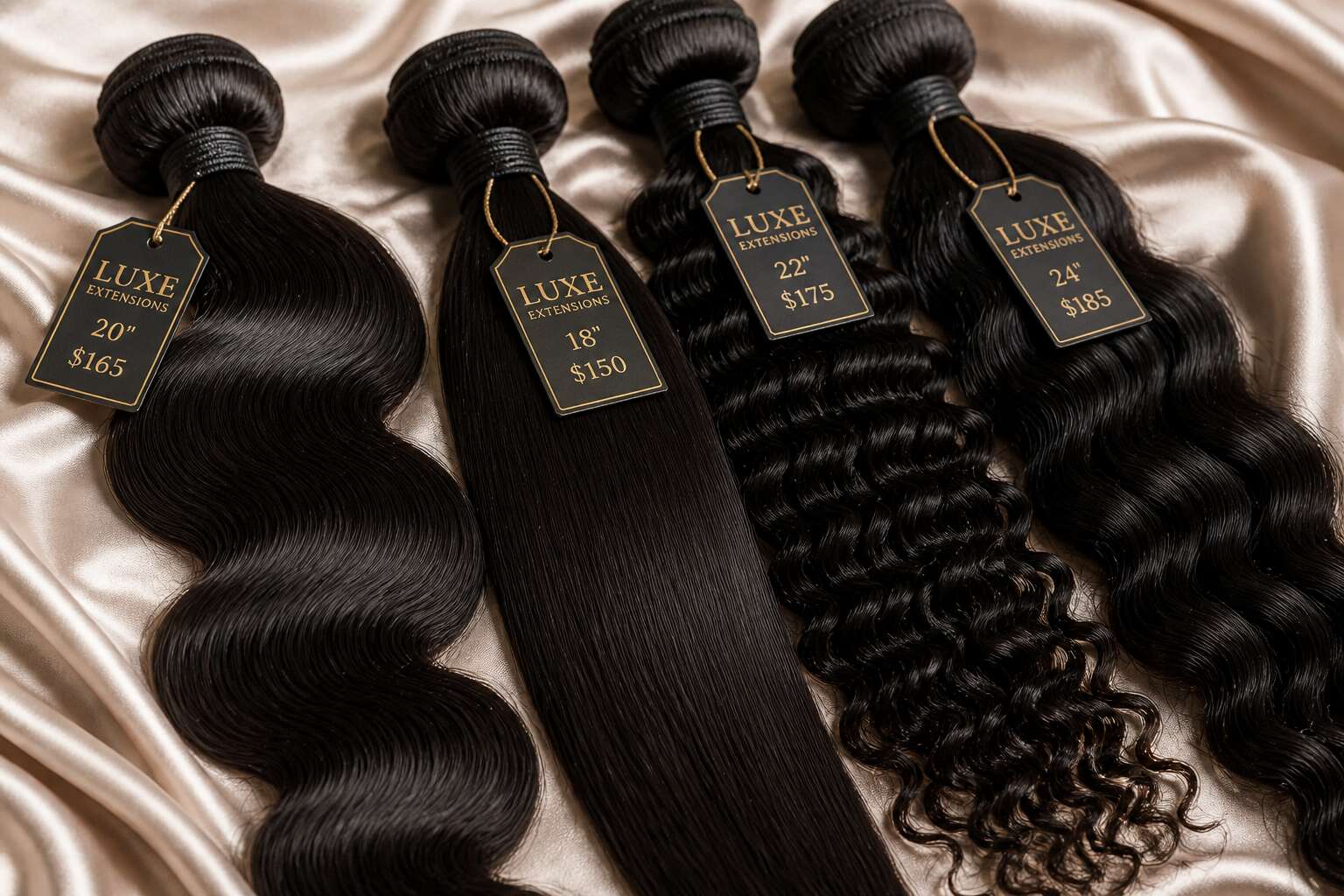
Understanding Authentic Hair Weave Categories
Differentiating Genuine Human Hair from Synthetic Blends
The hair market contains many fiber types, yet authentic strands respond differently to heat. Categorising hair by cuticle alignment reveals what you are truly paying for. Original weaves and their prices rise when cuticles remain intact.
Genuine human hair resists tangling and reacts to styling tools naturally. Synthetic blends often contain plastic fibres that melt under heat. I find that a burn test reveals the truth: real hair turns to ash, synthetics bead into resin.
- Run your fingers along the strand; human hair feels smooth.
- Check the ends; synthetic wigs have a dull finish.
- Inspect the weave pattern; human hair wefts vary naturally.
That discernment matters because these weaves cannot be judged by colour alone. Low-cost blends mimic shine but fail the touch test.
Virgin vs. Remy vs. Non-Remy Hair: What Justifies the Markup
Price tags on hair weaves often obscure the real quality. Virgin, Remy, and non-Remy hair each follow a different path to the shelf.
Virgin hair comes from one donor and never touches chemical treatment. Remy hair keeps its cuticles aligned and faces only light processing. Non-Remy hair loses the cuticle entirely, which reduces its lifespan.
- Virgin: unprocessed, highest cost
- Remy: aligned cuticle, mid range price
- Non-Remy: stripped cuticle, low cost
These layers explain why original weaves and their prices align with cuticle integrity. A virgin bundle costs double a non-Remy alternative for tangible reasons.
Geographic Sourcing and Its Impact on Price Tags
Somewhere between the scalp and the shelf, a journey unfolds that dictates the final figure on a price tag. The origin of the hair is not a mere detail; it is the very signature of its worth. Indian temples, Russian winters, and Peruvian valleys each yield a different texture, a different strength, and a different cost. This geographic sourcing is the silent architect of original weaves and their prices, a truth that many vendors prefer to leave in the shadows.
Climate and diet engrave themselves into the strand. A woman from a humid region grows hair that behaves differently than one from a dry, cold landscape. The rarity of the source further fuels the fire.
– Brazilian hair offers density and a natural wave.
– Peruvian hair is prized for its softness and versatility.
– Indian hair is often the most affordable and abundant.
These factors create a hierarchy. The more difficult the hair is to collect ethically, the more you will pay for the privilege of wearing it. So, when you hold a bundle in your hand, remember that you are not just holding a product. You are holding geography, history, and a silent narrative of its origin, all woven into the strands that frame your face. The cost is simply the price of that story, and in Cape Town, the discerning client knows that true value never whispers; it demands to be seen.
Price Determinants for Genuine Weaves
Grade Classifications and How They Move Pricing
Understanding how grades are assigned reveals the true architecture behind original weaves and their prices. This classification system is a formal hierarchy, translating raw texture and density into a tangible number that dictates your final investment. It is not about brand names; it is about measurable quality thresholds.
The tiers operate on a simple principle that aligns cost with meticulous sorting:
– Grade 5A: The foundation level, offering reasonable density and shine for everyday styling.
– Grade 6A to 7A: A noticeable upgrade in cuticle alignment and weight, reducing tangling during wear.
– Grade 8A and above: These represent the pinnacle of selection, where every strand matches perfectly in length and thickness.
Each step up the ladder represents a more rigorous selection process. Higher grades require that only the healthiest strands pass inspection, which naturally limits the supply. Consequently, the final quotation for original weaves and their prices scales steeply with each grade increment, rewarding those who seek longevity and flawless movement over budget-conscious compromises.
Cuticle Alignment and Processing Requirements
The grade on the tag is only half the story. The true price of original weaves and their prices hinges on two invisible factors: cuticle alignment and the processing method. A high grade tells you the hair was densely packed and long. It does not tell you if every strand flows in the same direction. If the cuticles are misaligned, the hair will mat and tangle within weeks, regardless of its initial quality. That tangling is not a styling issue. It is a structural failure.
Hair that comes from a single donor, or is collected in wefts with the roots aligned, requires deliberate handling. The cuticle layer must remain intact and facing downward. This alignment prevents friction between strands, preserving the silkiness you paid for. The meticulous labor involved in sorting and orienting the hair significantly elevates the final cost.
Processing is where value is saved or lost. Virgin hair, which has never been chemically treated, needs only a gentle wash and steam. Remy hair, while also premium, may undergo a light acid bath to smooth the cuticle. The harsher the chemical process used to strip color or force a uniform texture, the shorter the lifespan of the weave. That is why original weaves and their prices vary so wildly; you are paying for the absence of damage, not the presence of brand names. Cheaper options are often double-dipped in silicone to fake shine, which wears off quickly and leaves a brittle, matted mess.
Length, Weight, and Fullness: Measuring What You Pay For
Length is the easiest number to fake. A vendor can stretch a curly weave to claim eighteen inches when it barely reaches sixteen. Weight tells a truer story. Genuine hair carries heft. A standard weave of twenty inches should feel substantial in your palm, not as flimsy as a receipt. Fullness is the density across the weft, which determines whether your style holds volume or falls flat.
Original weaves and their prices are inseparable from these three metrics. When I pick up a bundle, I squeeze it. I shift the weft against the light. You are paying for mass and uniformity, not just a number on a tag. That is the difference between a bargain and an investment!
Brand Reputation Versus Product Quality Premiums
Nobody pays a premium for the privilege of owning scissors, but a brand markup on hair seems acceptable. Original weaves and their prices are often set by perception, not keratin. A bundle from a famous label might cost double, yet the strands under a microscope do not reveal which box they came from.
Reputation does buy consistency, though. Established vendors invest in grading, sorting, and quality checks. That diligence has a cost. Smaller sellers may offer lower prices but gamble with inconsistent batches.
- Celebrity endorsements inflate the base cost
- Packaging adds no value to the hair itself
- Customer support becomes a hidden premium
Brand premiums fade when the weft thins after three washes.
Wholesale Sourcing Channels versus Retail Store Markups
Wholesale sourcing channels live in the shadow of the retail floor. A trader in Durban importing directly from Vietnam or Brazil can pay a third of what a Sandton boutique charges for the same bundle. That gap is not mystery. It is logistics, currency shifts, and the cost of four walls and a locked door. The strands do not change. The address does.
Retail store markups are a tax on convenience and urgency. You walk in, you feel the weft, you walk out with a bag. That immediacy carries a price. Wholesale buyers wait, negotiate, and accept bulk. They also take on risk: no showroom, no returns, no gentle lighting to hide dry ends. The price difference is compensation for that gamble.
When you compare original weaves and their prices across channels, ask what you are funding:
- Wholesale: raw cost, shipping fees, customs duties
- Retail: rent, staffing, marketing, after-sales service
The markup is not vanity. It is survival. But original weaves and their prices seldom reflect the hair’s origin, grade, or longevity. Understand that, and the price tag becomes a map of the seller’s expenses, not the hair’s value.
Breaking Down Costs by Weave Type
Sew-In Weave Pricing Structures
In Durban, a sew in comes with two price tags: the hair and the hands. Original weaves and their prices rarely follow a simple formula. A basic weft sew in might run R800 to R1,500 for human hair, then R500 to R1,200 for installation, depending on location and stylist fame. The weave type matters more. Clip ins and tape ins cost more upfront because they need less hair and more prep, while traditional sew ins let you buy only the bundles you need. For a full head, expect three or four bundles. Here’s a quick breakdown:
- Brazilian straight wefts: R1,200 to R2,500 per bundle
- Peruvian body wave: R1,500 to R3,000 per bundle
- South African natural curls: R1,800 to R3,500 per bundle
Sew in pricing structures also factor in the cornrow pattern. Intricate braiding adds R200 to R400 to labor, because it takes time and skill.
Frontal and Closure Unit Cost Differences
In Durban, a single frontal unit can cost more than a full bundle of weft hair! That’s because frontals and closures are not the same product. A closure covers a small patch, typically 4×4 inches. A frontal spans ear to ear, which means more lace, more knots, and more labor. For original weaves and their prices, the distinction changes your total spend.
Frontal units range from R800 to R2,500 depending on lace quality and hair grade. Closures run lower, often R400 to R1,200. The added width of a frontal also requires extra installation time, adding R300 to R600 to labor costs.
- Frontals use more hair and wider lace, so they demand higher prices.
- Closures need less material, which lowers both the unit and install fee.
- Custom bleaching or tinting of knots adds R150 to R350 per unit.
Wig-Based Alternatives and Their Price Ranges
The true cost of a weave rarely rests on the hair itself, but on the labour and the architecture hidden beneath the net. In Johannesburg, a skilled hand installing a quick weave can command a premium, yet the price often reflects the stylist’s artistry as much as the canvas they work on. Choosing between a traditional sew-in and a unit-based system changes the conversation around spend. Each method offers a different relationship between time, damage, and the final drape of the hair. When comparing original weaves and their prices, the installation method dictates the frequency of maintenance and potential for breakage.
Because hair is often purchased separately, the service fee is where many newcomers find surprises. A straight-back sew-in with a leave-out requires no additional lace, but leaves the nape and edges exposed to the elements. Alternatively, a closed weave creates a protective style that works for longer periods.
To clarify the market:
1. Basic Sew-In (Leave-Out): Service fee from R350 to R700. A fast, economical option, though heat damage to the leave-out is a risk.
2. Straight-Back Sew-In (Closed Weave): Service fee from R600 to R1,200. This offers total protection for the natural hair.
3. Full Lace Unit Install: Service fee from R800 to R1,500. The unit itself often replaces the need for a full service, but the installation requires precision and strong adhesive.
Investing in a high-quality attaché or a quarterly subscription for hair care products is wise. Yet, the cheapest route is not always the most economical. A premium service often includes a wash, blow-dry, and a deep conditioning treatment to prepare the scalp, ensuring the grid of the cornrow sits neatly against the skin. These treatments add R100 to R300 to the bill but extend the life of the style significantly.
Clip-In and Tape-In Weave Cost Comparisons
Clip-in extensions seem like a bargain, yet the price omits daily styling and removal. Tape-ins sit flatter and last eight weeks, but the service fee starts at R400 and climbs with maintenance. When comparing original weaves and their prices, clip-ins cost R800 to R1,500 outright, while tape-ins require salon visits every two months. Most clients pay R250 to R500 per repositioning session. Over a year, the gap reverses. Consider the recurring spend:
- Tape-in removal and reinstallation: R250 to R500 per visit
- Adjustments and scalp treatments: R100 to R200
Clip-ins skip these fees but demand careful handling at home.
Regional Pricing Variations for Premium Hair
Why Salons Near You Charge More Than Online Retailers
The chasm between a Rand figure quoted in a salon chair and the price tag attached to a strand online often confuses the uninitiated. However, the mathematics of transformation are not so neatly calculated. Salons are not merely selling you a bundle of hair; they are trading in a curated experience, one that includes plumbing, electricity, and the expertise of a stylist who knows your scalp better than you do. These operational costs are woven into every unit.
For a consumer, the price reflects the physical goods. For a salon, the price reflects the physical premises. When you purchase original weaves and their prices online, you are viewing a wholesale figure divorced from the context of a physical consultation. Online retailers operate in vast warehouses, avoiding the premium rent of high-traffic shopping districts. You are effectively a logistics manager for yourself when you buy this way, which is a worthy trade-off for some.
Yet, the story deepens when considering the intangible assets of a storefront. A salon offers a tactile inspection that no high-resolution image can replicate. You pay for the ability to touch the hair, feel the weight of a custom color match, and benefit from the immediate aftercare services that often accompany a premium purchase.
Here is what your salon fee often covers that your online cart does not:
– Immediate replacement if the bundle is defective
– The overhead of stocking multiple hues for instant color blending
– The insurance and licensing for on-site specialists
– A physical location for accountability and claims
These costs are immaterial to a central warehouse that ships internationally. The relationship is different. The transformation from a visitor to a client justifies a markup that feels personal, because it is. The zeroes on the receipt simply tell a different side of the story, one where convenience and professional judgment are factored into the final sum.
Local Salon Premiums on Top of Hair Costs
Sandton and Soweto may share a city border, yet their salon receipts tell divergent tales. Regional pricing variations for premium hair begin with rent, but they do not end there. Local salon premiums on top of hair costs cover the stylist’s years of training, the chair’s depreciation, and the overhead of keeping a storefront lit through load-shedding. Original weaves and their prices shift according to what a neighbourhood can sustain. In upmarket suburbs, client expectations demand a wider inventory, from virgin lengths to custom-blended shades. That stock sits idly until purchased, and the cost of idle capital appears on your invoice. Consider what varies:
- Property rental per square metre
- Skilled labour rates and scarcity
- Logistics for import and delivery
These factors carry a heavier weight in some provinces. The same bundle from the same supplier will always wear a different price tag in Cape Town than in Polokwane.
Import Duties and Shipping Fees That Inflate Final Price
Every bundle crossing our borders carries a hidden surcharge. Import duties and shipping fees do not arrive as a flat rate. They shift with exchange rates, fuel prices, and the port of entry. Durban receives containers cheaper than Johannesburg, but inland haulage adds its own weight. That is why original weaves and their prices differ between coastal and inland cities.
Consider the chain. A supplier in China pays export taxes. A South African importer pays customs duties, VAT, and logistics insurance. Then a courier charges for the final leg. Each step inflates the final price before a stylist even touches the hair.
- Customs duty percentage based on hair type
- Shipping container rates from origin ports
- Fuel levies for inland trucking
These fees vary monthly. A salon in Cape Town may absorb lower shipping costs, while a Polokwane boutique pays for a longer road. The result is a pricing map that changes with every oil barrel.
Spotting Fair Prices Versus Hidden Scam Margins
Red Flags for Counterfeit Products Priced Too High
A single bundle of hair can cost R1,500 or R15,000. That gap has nothing to do with magic and everything to do with knowing what you are actually holding. The market for original weaves and their prices is crowded with middlemen who bank on confusion, turning a simple purchase into a gamble where you are the only one who loses.
Fair pricing starts with the raw material. A genuine Remy cuticle, unprocessed and intact, takes time to source and sort. Workers carefully align each strand by hand, discarding the short, broken pieces that cheaper vendors blend back in. When you pay R3,000 for a bundle that should cost R8,000, you are not getting a deal. You are getting factory seconds, synthetic filler, or a processed cuticle coated in silicone to hide the damage. The price structure tells the truth if you listen.
Several red flags signal an inflated or dishonest price tag:
– A deal that undercuts every reputable vendor by 40 percent or more. Nobody sells premium hair at a loss.
– Vendors who cannot explain the difference between virgin, Remy, and non-Remy hair. Knowledge costs money to acquire; ignorance is cheap.
– Bundles that feel unnaturally silky or smell faintly of chemicals. That is the silicone signature.
– Weight discrepancies. A standard bundle should feel dense. If it feels light, count the strands; you are paying for air.
The craft behind a good install deserves fair compensation too. A stylist who charges R1,500 for a sew-in is not overcharging. They are paying rent, sterilising tools, and replacing needles after every client. The R500 stylist might do the same job, but they are likely skipping the sanitation or rushing the braid work, which leads to tension and breakage. Compare the price against the time spent, not just the final look.
Location also shifts the numbers. A salon in Sandton carries higher overheads than one in a rural township, and that difference shows up in the invoice. It does not automatically mean the expensive option is better, nor does the cheaper one guarantee a scam. You are paying for the experience, the ambience, and the convenience. Understand what the markup covers before you hand over your card.
When you finally spot the difference between a genuine product and a clever imitation, you will feel it. The weight, the movement, the way the hair springs back without tangling. Original weaves and their prices will never be a secret again once you learn to read the signs. Fair value is not about the lowest number. It is about the honest work behind every strand.
Comparing Per-Gram Costs Across Different Textures
When shopping for extensions, the most reliable way to compare value is by breaking down the cost per gram. Many vendors advertise a bundle weight of 100 grams, but the actual usable hair after trimming the weft can be significantly less. This discrepancy is where hidden margins often hide, making the price per gram the truest measure of what you are actually paying for.
Original weaves and their prices do vary, but the variance follows a logical pattern. To calculate this, you simply divide the total cost by the net weight. However, you must first ask the vendor if the weight includes the weft or if it is pure hair. A cheaper bundle that weighs 80 grams after weft removal is often a worse deal than a pricier one that delivers the full 100 grams. The per-gram price clarifies which purchase actually offers the better economy.
Several factors influence this per-gram figure. You should consider:
– Texture Type: Heavily processed textures like deep curls often lose weight during processing, so a lower per-gram price may indicate excessive chemical stripping.
– Origin Point: Standard South American hair might cost less per gram than rare European or virgin Asian strands, reflecting the supply chain’s complexity.
– Processing Level: Virgin hair, untouched by chemicals, commands a higher fraction, whereas ethically sourced but processed hair sits in a mid-tier bracket.
Comparing numbers across different textures requires nuance. A fine, silky texture is denser by weight, meaning fewer grams are needed to create volume. A coarser texture weighs more but spreads thinner. Consequently, the lower-priced coarse hair might actually require an extra bundle to achieve the same look, erasing any initial savings. You must project the total project cost.
Furthermore, the quality of the processing affects the longevity per gram. Low-quality hair tangles and sheds, losing volume quickly after washing. This means the effective cost over the lifespan of the weave increases steeply. You are not just purchasing weight; you are purchasing durability. A higher price per gram for hair that lasts six months is ultimately cheaper than a cheaper option that dies after two.
Ultimately, the per-gram metric acts as a compass. It directs you toward the actual worth of the hair, stripping away the emotional pull of a low bundle price. By focusing on this precise measurement, you ensure your budget is allocated to raw material quality, not just a misleading label. This calculation bridges the gap between what a product looks like online and what it will be like on your head, offering a clear, data-driven path through a market often clouded by subjective pricing.
Leveraging Loyalty Programs and Bulk Purchase Discounts
Assessing the Total Lifetime Value of a Purchased Weave Unit
Longevity Expectations That Justify Higher Price Points
The price per month, not per unit, determines value. A premium weave unit can deliver eight months of wear. Original weaves and their prices become clear when you divide the cost by weeks of use.
Longevity depends on how you treat the hair between appointments. A unit that sheds less than a fifth of its volume after washing is worth the premium. Realistic expectations matter. Heavy styling cuts lifespan dramatically.
- Daily washing reduces longevity by half.
- Using low tension styles extends it.
Higher price points are justified when texture and fullness survive past the four month mark.
Care and Maintenance Costs That Add Up Over Time
Assessing the total lifetime value of a purchased weave unit reveals hidden financial obligations that escape the initial invoice. Original weaves and their prices require rigorous comparison against the recurring costs of upkeep. I find that the true barometer of affordability includes the ancillary expenses that proliferate in the first three months.
You will need specialized cleansing agents and life-extending treatments. Consider the financial outlay for:
- Premium hydrating masks and restorative oils
- Professional laundering or steaming services
- Reinforced stitching and tension checks by a stylist
These costs often mirror the unit’s retail price, reflecting a hidden renewal cost. Any accurate calculation of original weaves and their prices must integrate these prolonged expenses to remain viable for the long term.
Resale or Recycling Options for Gently Worn Extensions
When the gloss fades and the tracks start to feel like a burden, the question of resale or recycling enters the conversation. Original weaves and their prices rarely account for the afterlife of the unit, which is a shame because gently worn extensions hold real value in South Africa’s hair market.
Consider the options before relegating your weave to the bin:
- Private resale through community marketplaces, where a well-maintained Remy unit can recoup a third of its cost.
- Donation to wig banks that service medical hair loss patients.
- Trade-in programs offered by select salons that credit your next purchase.
Each route demands honest assessment of the unit’s condition. Original weaves and their prices only make sense when you factor in this residual worth. A weave that survives three months of Cape Town humidity has delivered value, and possibly to a new owner.



0 Comments