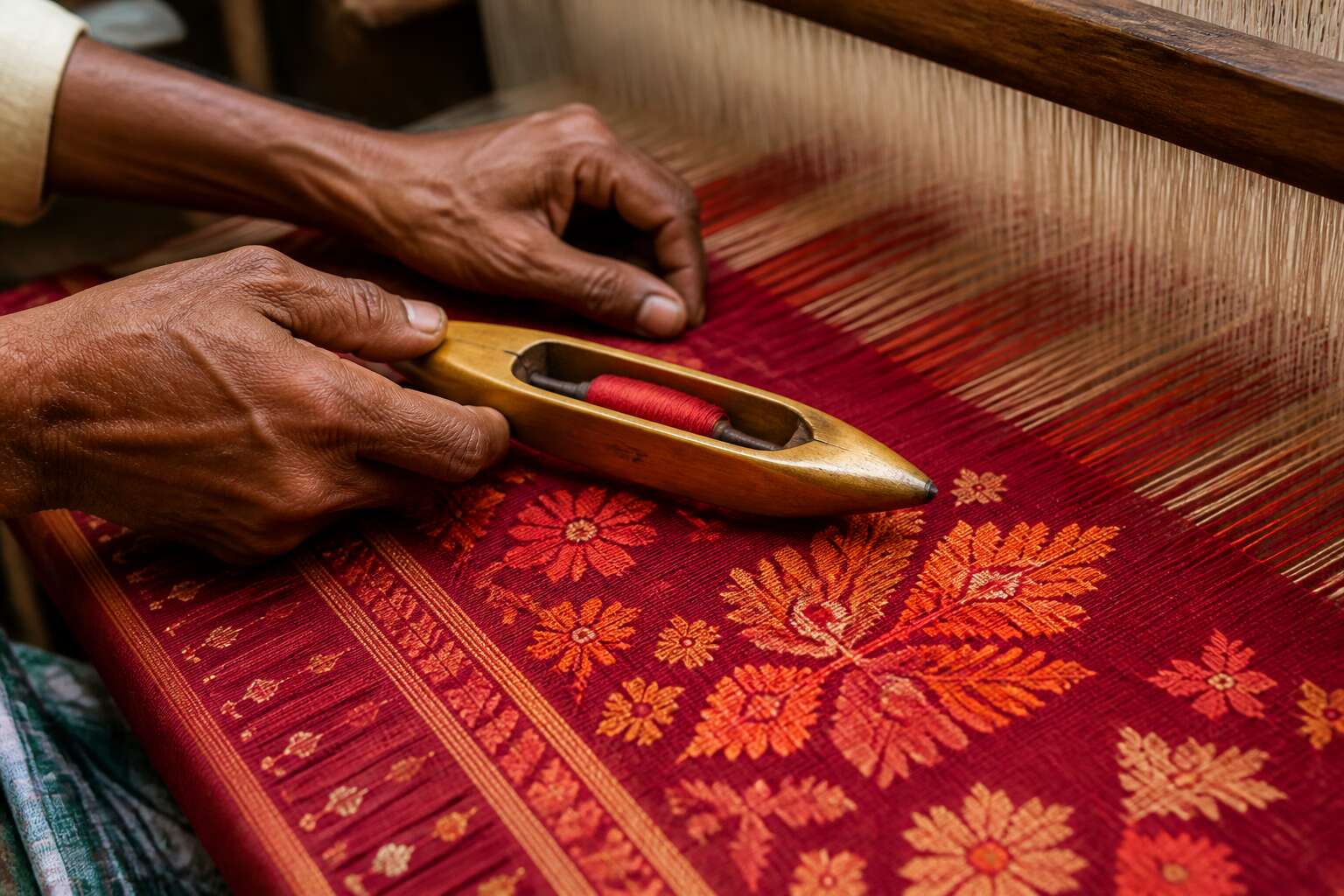
The Legacy of Bengal’s Handloom Heritage
The Golden Era of Muslin
The golden era of muslin came under royal patronage, when master weavers produced cloth that seemed to defy logic. A complete saree, folded, could fit inside a small snuff box. That refinement was no accident. It emerged from a legacy of handloom heritage stretching back many centuries, where communities along the Bhagirathi River perfected every step from ginning to weaving. Today, the weaves of west bengal still echo that discipline.
Among the celebrated varieties were:
- Mulmul, the soft standard for everyday luxury
- Khas, a finer weave reserved for nobles
- Abrawan, so translucent it was named flowing water
The popularity of these textiles reshaped trade routes and drew merchants from distant lands. Their arrival in foreign courts turned Bengali cotton into a universal symbol of craft excellence, a reputation that persists in every handloom piece produced here.
Handloom Culture Across Generations
I recall watching a fifth generation weaver near Shantipur set up his loom before sunrise. The ritual mirrored his great grandfather’s, down to the way he tied the warp threads. This continuity forms the true foundation of the weaves of west bengal. It lives in the calloused hands of artisans who treat every shuttle throw as a link to their forebears.
The weaves of west bengal carry generations of embedded knowledge. Young weavers learn through immersion, not manuals. They absorb the rhythm of the pit loom, the tension of the warp, the discipline behind intricate borders. Entire families participate, each member holding a distinct role.
The community structure enables this transmission:
– Elder weavers guard the traditional motifs
– Women handle pre weaving tasks like winding and sizing
– Children absorb technique through observation
This generational pipeline preserves the integrity of every piece.
Royal Patronage and the Cottage Industry
Royal courts across Bengal once dictated the rhythm of production. They commissioned specific weaves for coronations, wedding trousseaus, and seasonal festivals. This patronage transformed cottage looms into a significant economic sector.
During the Mughal period, the state appointed tapedars, inspectors who tested fabric against standard weights. A cloth failing inspection was rejected outright. This accountability created an expectation of precision that persists today.
The cottage industry operated on a structured cycle:
- Local merchants advanced yarn to weavers.
- Weavers delivered finished cloth on fixed schedules.
- Courts absorbed the surplus at premium prices.
That supply chain collapsed under colonial rule, but its influence remains in every bolt of fabric. The weaves of west bengal still carry that legacy of disciplined craft. I felt that discipline when I traced a Baluchari border with my fingers.
Distinctive Fibers: Cotton, Silk, and Tussar
Three fibers define Bengal’s handloom repertoire: cotton, mulberry silk, and tussar. Cotton from the river deltas produces a short staple that spins into breathable, whisper-light cloth. Mulberry silk, called pat in local weaver parlance, comes from domesticated worms that feed exclusively on mulberry leaves. Tussar is the wild sibling, harvested from cocoons spun on sal and arjun trees, its thread releasing a natural golden lustre that no chemical dye can mimic.
Weavers read these fibers by their behaviour:
- Cotton must be starched before it accepts colour.
- Pat responds only to a steady, gentle hand.
- Tussar’s coarse irregularity makes every yard unique.
From this interplay of fibre, the weaves of west bengal draw their enduring complexity.
Signature Fabrics and Craftsmanship
Tangail Sarees and Their Geometric Borders
Tangail sarees are defined by geometric borders. These grids of tiny squares and diamonds emerge thread by thread on the loom. Weavers in East Burdwan and Nadia districts maintain this legacy today.
The border patterns follow a mathematical rhythm. The anchal, or end piece, frequently features a contrasting stripe. The body stays plain, allowing the border to command attention. This interplay between restraint and ornament defines Tangail craftsmanship.
What separates these sarees within the broader weaves of west bengal is the conja technique, a method of interlocking threads that produces a crisp edge surviving multiple washes. I have seen century old Tangails retain their geometric edges perfectly.
Common border motifs include:
- Tiny shik or parrot motifs
- Diamond shaped kauper patterns
- Horizontal stripes with a central band
Each motif carries a local name. A seasoned weaver can trace a saree’s village of origin by the border alone.
Jamdani: The Art of Woven Dreams
Jamdani demands patience most modern workshops no longer possess. On the low-slung looms of Phulia and Dhanyakuria, a single sari takes up to six months. The designs are not printed or embroidered. They emerge from a technique called discontinuous weft, where extra threads are inserted by hand into specific points of the ground cloth.
The process requires two people. A master weaver operates the loom while an apprentice reads a gridded card chart and calls out every thread placement. These charts are handmade and closely guarded by weaving families across the weaves of west bengal.
Several structural traits define this craft:
- The supplementary weft threads float between motifs, never crossing the full fabric width
- Patterns appear on both surfaces with equal clarity
- The ground weave is so fine that humidity levels in the shed control the thread’s behaviour
I have watched these motifs take shape, each line of the chart settling into the warp with a soft tap from the beam.
Baluchari Narratives in Silk
Baluchari silk saris carry entire epics in their borders. On the looms of Bishnupur, weavers spent months translating Ramayana scenes into motifs. The craft nearly vanished when royal patronage ended, but a few families preserved it. What sets Baluchari apart is its narrative density. Every border row depicts a moment: a royal procession, a goddess in her chariot, a British officer smoking a pipe. The weaves of west bengal owe this storytelling tradition to pictorial silks.
The loom uses a Jacquard attachment fed by punched cards. An artisan interprets painted scrolls into card sequences. The weaver throws the silk weft, and the pattern emerges in reverse, meaning the weaver memorizes the design backward.
- The ground uses mulberry silk.
- The border and pallav use dyed silk and sometimes gold thread.
- A single sari can contain over a thousand motifs.
Each Baluchari is a library woven in thread.
Dhakai Weaves and Ultra-Fine Counts
The weaves of west bengal reach their peak in Dhakai weaves, where ultra-fine counts turn raw cotton into a fabric so light it barely registers on the skin. I have seen spinners on the Nadia border produce yarn so thin that a single kilogram runs for days on the charkha. The loom work is slower than other traditions because the warp threads snap under their own fineness.
This is not a craft for impatient hands! A sari may use 100s count yarn, creating a drape that folds into a fistful. The finishing process includes starching and beating the cloth with a mallet to close the weave.
- Counts above 80 are standard, with some reaching 120
- The yarn is spun on a low-torsion spindle to keep it soft
- Weavers work in shaded rooms to prevent the thread from drying
The weaves of west bengal thus carry a living standard of precision, one that rewards patience with a garment of almost translucent grace.
Korial Sarees and the Cult of White
Among the weaves of west bengal, Korial sarees hold a peculiar reverence. These are not dyed or printed. They are woven in stark white, then embroidered with white thread, creating a play of light and shadow that shifts with every fold. The effect is almost architectural, a study in restraint.
The craftsmanship demands a steady hand. Artisans use a fine needle to work intricate floral motifs along the border and pallu. Each stitch is deliberate, and the fabric is often left unwashed to preserve its crispness. Consider the hallmarks:
- White-on-white embroidery on jamdani or mulmul base
- Motifs drawn from Mughal floral patterns
- Thread counts that rival the finest muslin
This cult of white is not mere aesthetics. In Bengal, white signifies purity and is reserved for ceremonial moments. Yet the Korial is also a test of patience. One sari can take months. The weaves of west bengal, in this form, become a meditation on absence rather than excess.
Artisan Communities and Weaving Techniques
The Weavers’ Guilds and Family Traditions
A weaving family in Shantipur passes its craft from parent to child, a system older than any formal school. The guilds of Bengal operate as quiet regulators, setting wages, sourcing threads, and protecting the integrity of each design. This is how the weaves of west bengal survive as living traditions, not museum pieces.
The guild’s role is practical:
- Controlling the purchase of raw silk and cotton.
- Negotiating orders with merchants.
- Settling disputes when a design is copied.
Within the home, daughters learn to set the warp before they learn to read. This intergenerational transfer remains the core of the industry. I have watched an eight year old wind bobbins beside her grandmother, absorbing rhythm and patience with every turn of the wheel.
Pit Looms Versus Frame Looms
On a pit loom, the weaver sits low, feet in a hollow carved into the earth. The warp threads run at floor level, which keeps tension steady and cloth even. A frame loom lifts everything to chest height, enabling faster footwork and wider fabric. Artisan communities across Bengal treat the two as separate trades, not variants.
Pit looms dominate in Nadia, where fine cottons demand slow precision. Frame looms hold sway in Bishnupur, where heavier silk needs stronger beating.
Key differences:
– Pit looms require the weaver to cross legs under the beam, using toes to adjust tension.
– Frame looms use a shuttle race and foot pedals, allowing a single weaver to produce broader lengths.
This division shapes the weaves of west bengal. Airy cottons emerge from dug earth; dense silks come from raised wooden frames. The village’s ground itself decides what gets woven.
Natural Dyes and Color Stories
In Bengal, color is not an afterthought. It comes from the dyer’s hand and the river’s water. Artisan communities in villages like Phulia extract dye from alizarin, indigo, and the bark of the jackfruit tree. These natural dyes respond to the season, the water’s pH, and the weaver’s patience. The weaves of west bengal carry these stories in every thread.
- Indigo for deep blues, fermented in earthen pots.
- Madder root for rust reds and earthy browns.
- Turmeric for yellows, though it fades with sunlight.
These colors shift with each batch, making every saree unique. For the weavers, this is strength, not flaw. The dye seeps into the cotton or silk, and the cloth holds the trace of that particular morning. No two lengths ever match exactly, and that irregularity is the very signature of a handwoven piece.
Countless Hours Behind a Single Saree
Behind every weave of west bengal sits a community that counts time in threads. A single silk saree can consume weeks of labour: the warp is measured precisely, the design charted on graph paper, and the thread tensioned by hand. Across the weaving hamlets, artisans rise before dawn while the air stays cool.
- Preparing the warp takes two full days.
- Charting the motif can take another week.
- Weaving a single border consumes three days.
I have watched those hours collect. An artisan runs a fingertip across the finished pallu. That small gesture holds every afternoon bent over the loom, every counted thread, every patient correction. The effort sits in the cloth’s own rhythm. Nothing about the weaves of west bengal happens quickly. That is precisely the point.
Intergenerational Transfer of Skills
In the weaving hamlets, children learn by watching before they ever touch a shuttle. A grandfather corrects a granddaughter’s grip, a mother shows how to count threads by feel. The knowledge passes through demonstration, not manuals. This daily transfer keeps the weaves of west bengal alive across generations.
The community enforces its own standards. A weaver who rushes a border faces quiet criticism from neighbors who know better. The learning sequence follows a strict rhythm:
- Observing the warp being dressed
- Assisting with bobbins and shuttles
- Weaving plain sections under supervision
- Attempting the first border motif
Only after years of this progression does an artisan work independently. The loom passes from parent to child, and the village itself enforces the standard.
Regional Clusters and Their Specialties
Shantipur and the Magic of Fine Cotton
Shantipur’s looms produce a distinct texture among the weaves of west bengal. Here, cotton is spun to a remarkable fineness, often reaching counts that rival historical muslin.
The magic lies in the yarn preparation. Weavers use a specific twist and a light starching that gives the fabric a crisp yet breathable character. This cloth feels smooth and cool against the skin, ideal for the humid climate.
- The single warp and weft structure allows for dense yet airy fabric.
- Traditional jamdani motifs are often recreated on this fine ground.
When I walk through the lanes, I see patience in every shuttle throw! The result is a saree that weighs almost nothing, yet carries a distinct body. That is Shantipur’s magic, a key name in the weaves of west bengal. Each piece reflects the weaver’s intimate knowledge of tension and twist, a skill passed down through quiet observation.
Murshidabad’s Silk Legacy
Murshidabad’s silk legacy is so deep that entire villages still measure their calendars by the mulberry harvest. When the Bhagirathi floods recede, the worms begin their first cycle, and looms across the district hum with fresh urgency.
This silk is sturdy, with a crispness shaped by patient sericulture. The cocoons are boiled and reeled by hand, a technique that preserves the strength of the filament. The resulting thread carries a sheen that catches light without glitter.
Within the weaves of west bengal, Murshidabad occupies a particular terrain. Its looms produce silk with an audible rustle, a signature of proper twist. Specialties still woven here include:
- Dense dupion with visible slubs
- Brocade borders carrying regional motifs
- Untwisted silk for ceremonial thread
This heritage survived colonial disruption and mechanised competition. Murshidabad’s silk remains a living craft.
Bishnupur and the Baluchari Connection
Bishnupur’s identity as a weaving cluster rests on a specific, inherited discipline. The weavers here trace their craft directly to the Malla court, and their Baluchari sarees remain loyal to that origin. They render narrative panels in silk without zari, a choice that demands extraordinary patience.
The recurring elements are consistent:
- Courtly processions with attendants and riders
- Elaborate floral scrolls around the pallu
- Depictions of hunting scenes from local lore
The cluster is not large, but its output defines a major thread in the weaves of west bengal. Every imitation elsewhere in the state ultimately points back to this temple town.
Fulia’s Expertise in Dyeing
A short distance north, Fulia commands a different kind of authority. This cluster along the Jalangi river specializes in preparing color before thread ever meets a loom. The dyers here run the preparatory stages for Shantipur, for Tangail, for the entire Nadia belt. They age madder roots, ferment indigo vats, and gauge alum by eye.
Weavers depend on Fulia’s precision. A single uneven batch ruins months of work, so the dyers maintain exacting standards across every hank they return. This expertise makes the cluster an invisible engine within the weaves of west bengal. The craft is not glamorous, but it is foundational.
Halphali’s Tussar Treasures
North of Fulia’s dye pits, in Halphali, tussar silk begins with a hole. The wild silkworm chews free of its cocoon before any human can reach the thread. Weavers gather the damaged cocoons and reel them into filaments. This defect is the foundation of their trade.
Halphali’s tussar treasures arrive as rough, undyed skeins. The finished cloth carries a forest scent and a heavier drape than cultivated silk. It resists the clinical uniformity prized by mill owners. The irregularity is the mark of authenticity.
The cluster works its own rhythm:
– Handspun reeling keeps the natural gum intact.
– Every hank starts with the moth’s escape.
– No two cocoons surrender identical filaments.
This method binds Halphali to the older instincts within the weaves of west bengal. The insect departs, the weaver completes. Across the state’s scattered clusters, the weaves of west bengal stay resilient because of this patient arrangement. That partnership is not accidental; it is ritual.
Revival, Trends, and Global Appeal
Geographical Indication Tags and Protection
The weaves of west bengal are experiencing a curious renaissance, driven not by nostalgia alone but by a generation of designers who treat the loom as a laboratory. Revival here means reinterpreting archival patterns for contemporary silhouettes, a delicate negotiation between heritage and wearability. One sees it in the quiet confidence of a Jamdani blazer or a Baluchari stole worn over denim.
Geographical Indication tags have become quiet guardians of this legacy. For the uninitiated, a GI tag functions as a certificate of origin, protecting specific weaves from imitation and ensuring that the name “Tangail” or “Murshidabad silk” cannot be casually borrowed by mass producers. This legal shield matters enormously for weaver cooperatives who lack marketing muscle.
– It prevents dilution of brand identity
– It secures premium pricing for authentic goods
– It empowers local communities to control their own narrative
Global appeal follows naturally when provenance is protected. Fashion houses in London and Tokyo now source directly from Bengal’s clusters, recognising that a product with a documented lineage carries a story no factory can replicate. The weaves of west bengal have moved from regional curiosity to international wardrobe staple, and the GI framework deserves a good portion of that credit.
Government Initiatives for Handloom Promotion
The loom does not follow the clock; it follows the cloth, laughs a Shantipur weaver. That patience now meets state-backed momentum, and it works! The revival of these weaves of west bengal leans on government initiatives as much as on designer whimsy. Schemes like the Mudra loan and the Cluster Development Programme supply working capital, shared infrastructure, and export training for weavers. These efforts target readiness, not mere survival.
Weaver cooperatives appoint design mentors who translate local motifs for global wardrobes, a practice that keeps the weaves of west bengal relevant. A burnt orange Korial with metallic accents sells steadily in Johannesburg boutiques. The global appeal of these textiles rests on documented provenance, a story no factory can counterfeit.
Priority areas remain:
- Digitised pattern libraries
- Direct-to-buyer digital fairs
- Childcare facilities near looms
These pragmatic measures stabilise income while keeping the looms clacking in Fulia and Shantipur.
Contemporary Styling of Traditional Weaves
Revival is not about freezing the past in glass cases. It is about letting the weaves of west bengal breathe in new forms. Urban buyers now drape a Tangail saree over tailored trousers, or wear a Baluchari blouse with denim. The loom responds to these impulses. A young designer in Kolkata samples old pattern books and reworks the scale of borders to suit shorter garment lengths.
Trends shift toward quieter luxury. The global appeal of these textiles rests on their irregularity. No two pieces match perfectly, and that honesty sells. Contemporary styling leans into that imperfection:
- Unbleached cotton paired with hand-block prints
- Silk sarees cut into structured tops and dresses
- Murshidabad tussar dyed in lichen and clay tones
Buyers in Johannesburg and Cape Town respond to the human trace left in every thread. The weaves of west bengal become a counterpoint to fast fashion, not because they are old, but because they refuse to hurry.
Sustainable Fashion and Ethical Handlooms
Every two seconds, a fast fashion garment gets chucked into a landfill. The weaves of west bengal do not follow that schedule. Revival here means the loom continues at its own pace, producing goods that are rarely identical. A Tangail border off by three millimetres? That is not a flaw. That is proof of a human hand.
Trends are catching up. Export houses in Kolkata tell me that buyers in Cape Town and Johannesburg now ask for unbleached cotton and clay toned dyes. The global appeal comes from transparency. Visible wages, recorded dye lots, and clean vats turn a saree into an ethical document.
Sustainable fashion needs proof, not promises:
- Weavers receive direct payments through cooperative ledgers
- Dye waste water gets filtered before it meets the Hooghly
- Every loom hour is logged so buyers can trace the energy cost
Now that is accountability! The weaves of west bengal hand you something polyester cannot. They hand you time, measured honestly.
How to Identify Authentic Handwoven Fabric
A single Tangail saree contains sixty hours of human labour. Revival of the weaves of west bengal is not a museum project. It is a living response to buyers who demand proof of provenance. On the looms of Shantipur, weavers now mark each batch with a timestamp, a small shift that lets collectors track a saree’s journey from cotton boll to finished drape.
Trends shift toward texture rather than shine. Matte finishes and raw edges appear in Durban boutiques. The irregular selvedge, once a hidden flaw, is now a signature. For the uninitiated, here is how to spot the genuine textile:
- Run your thumb across the surface. Authentic handwoven fabric gives a slight, organic resistance, not a slippery glide.
- Hold it to the light. Handloom threads never align perfectly; you will see tiny, uneven gaps.
Global appeal rests on this imperfection. Cape Town buyers pay a premium for the visible warp and weft. The weaves of west bengal do not imitate machine perfection. They preserve the arithmetic of the human hand. A border that drifts three millimetres is not an error. It is the weaver’s signature.




0 Comments